
How Vehicle Price Benchmarking Helps Dealers Price Used Cars.
- How Vehicle Price Benchmarking Helps Dealers Price Used Cars
- What Is Vehicle Price Benchmarking for Used Car Dealers?
- How Do Dealers Benchmark Used Car Prices?
- Why Is Vehicle Price Benchmarking Important?
- How Does Vehicle Price Benchmarking Affect Used Car Sales?
- Why Connected Dealership Pricing Matters
- Frequently Asked Questions
How Vehicle Price Benchmarking Helps Dealers Price Used Cars
Used car price benchmarking helps dealerships understand whether their vehicles are priced competitively against similar stock in the market. Price a car too high and it can sit on the forecourt while similar stock attracts buyers; price it too low and you could leave margin behind. The pressure is even greater now that customers can check prices for themselves before they walk through the dealership doors.
For buyers, a vehicle’s price is no longer something they have to take at face value. Online marketplaces and valuation tools make it easier to compare similar cars, check whether a price looks fair, and use that information when negotiating. For dealers, getting the price right isn’t just about selling the vehicle; it’s about being able to stand behind the price when a customer asks, “Why is yours £1,000 more than that one?”
What Is Vehicle Price Benchmarking for Used Car Dealers?
Vehicle price benchmarking means comparing a vehicle against relevant market information to establish whether its price is competitive. Dealers can look at similar vehicles based on factors such as age, mileage, specification, condition, location, and asking price before deciding where their own stock should sit.
The comparison needs to go beyond the headline figure. A three-year-old vehicle with 20,000 miles and a high specification shouldn’t be treated as directly comparable with another three-year-old example that has covered 60,000 miles and has fewer options. Good benchmarking gives dealers a clearer picture of what customers are seeing when they compare their vehicle with the rest of the market.
There is now considerably more information available than there was when printed pricing guides were the main reference point. Parkers was one of the best-known examples; today, dealers can use services such as Auto Trader, CAP HPI, Glass’s, DMS data, and their own sales information to understand where a vehicle sits in the market.
How Do Dealers Benchmark Used Car Prices?
There isn’t one source every dealership has to use. Different retailers will use different valuation and benchmarking services, alongside their own stock and sales data.
Auto Trader is one of the most visible sources, with dealer products providing information on market valuations, competitor vehicles, retail position, days in stock, supply, demand, and expected speed of sale. Other providers, including CAP HPI and Glass’s, offer their own valuation and market data, giving dealers several ways to sense-check a vehicle’s price.
DMS data can add another layer of context. A dealership already has information about its own stock, pricing, vehicle movements, sales, and margins; bringing that information together with external market data can make pricing decisions more grounded in what is actually happening on the forecourt.
Why Is Vehicle Price Benchmarking Important?
Getting the price right can affect how long a vehicle stays in stock, how much margin is available, and how easily a salesperson can justify the price to a customer.
That last point matters because buyers can benchmark too. A customer standing on your forecourt can look at similar vehicles online, compare mileage and specification, and question why your car costs more. If they can show that comparable vehicles are available for less, the dealership may have lost some negotiating power before the conversation has really started.
Being the cheapest vehicle isn’t necessarily the answer either. A dealership may have invested in preparation, warranty cover, additional specification, presentation, or other work that gives the vehicle a stronger proposition. Benchmarking helps dealers see where they stand without assuming that every comparable vehicle should have the same price.
How Does Vehicle Price Benchmarking Affect Used Car Sales?
There is a practical issue that can be easy to overlook. If a dealer regularly changes prices to keep vehicles competitive, those changes need to reach the customer-facing display as well as the online advert and internal systems. The more frequently prices move, the more difficult it becomes to keep every touchpoint consistent when updates are handled manually.
This is where paper or plastic pricing can become a headache. Every price change means someone needs to update the windscreen display, print a replacement, remove the old one, and put the new information on the vehicle. When a dealership has dozens or hundreds of vehicles, those small jobs quickly become a significant amount of administration.
It can also create an awkward situation for sales staff. A customer may have seen one price online, walked onto the forecourt, and found another price displayed on the vehicle. Even when the difference is caused by an update that hasn’t made its way onto the windscreen yet, the customer sees an inconsistency.
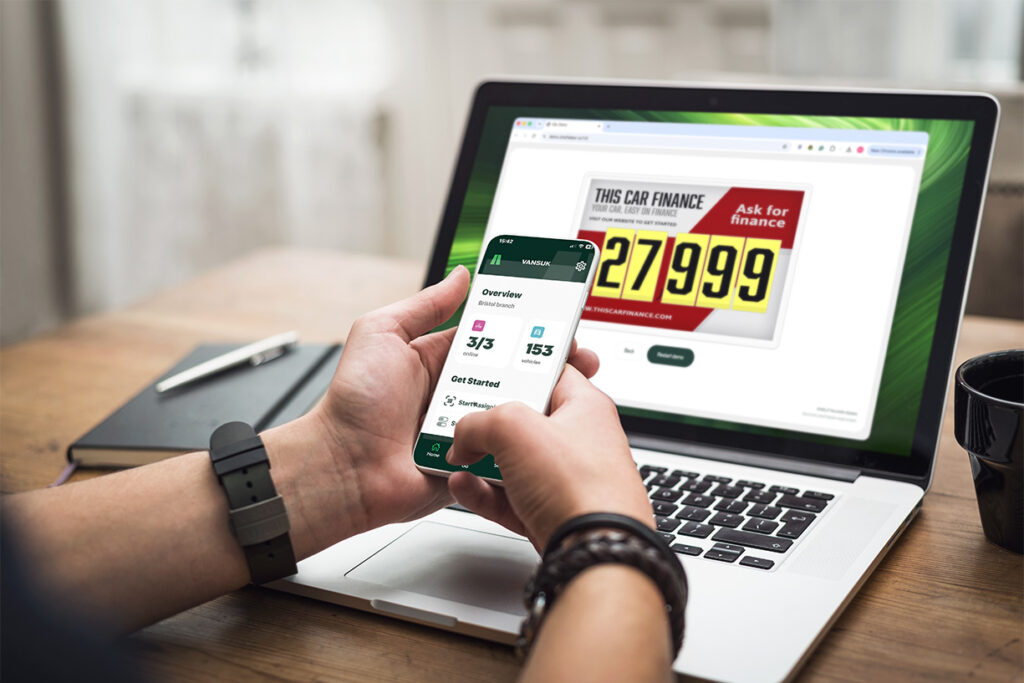
Digital pricing removes much of that friction. A dealer can make the pricing change within its connected systems and have the customer-facing display updated without printing and replacing a card.
It also means dealerships can respond to changes in the market without creating another manual task every time a vehicle’s price moves. That matters when pricing is being actively reviewed to keep stock competitive.
This is where AutoTalker fits into the wider process. It connects with dealership systems and third-party services, allowing information such as pricing, vehicle specifications, finance details, and promotional messaging to be displayed digitally.
If a dealer benchmarks a vehicle and decides to reduce the price by £500, the decision doesn’t have to end with changing an online listing. The corresponding digital display can be updated too, giving the customer the same information when they walk up to the vehicle.
That creates a more consistent buying experience and reduces the cost of the manual work involved in keeping the forecourt up to date. It also gives dealerships more flexibility when prices, finance offers, or vehicle information need to change.
Why Connected Dealership Pricing Matters
Dealerships rarely rely on one system. Stock information, valuations, advertising, finance, customer enquiries, and sales activity can all sit across different platforms.
The more often information changes, the harder it becomes to keep every customer-facing touchpoint accurate when updates are handled manually. A pricing decision made using live market data is only useful if the customer sees the correct price when they arrive at the vehicle.
AutoTalker connects with dealership systems and third-party services, helping retailers keep digital vehicle pricing displays aligned with the information being managed elsewhere. For dealerships that regularly review pricing, this can turn what was previously a repetitive forecourt task into part of the wider digital process.
Frequently Asked Questions
Vehicle price benchmarking is the process of comparing a vehicle with similar stock in the market to assess whether its price is competitive. Dealers can consider factors such as age, mileage, specification, condition, location, and current asking prices when deciding how to price a used vehicle.
Dealers can use a combination of online marketplaces, valuation services, DMS data, and their own dealership information to benchmark used car prices. Comparing similar vehicles helps retailers understand their position within the market and decide whether a vehicle should be priced higher, lower, or in line with comparable stock.
Dealers can use a range of vehicle valuation and market benchmarking tools to compare their stock with similar vehicles. Examples include Auto Trader’s retail valuation and competitor tools, CAP HPI, and Glass’s. Dealership management systems can also provide useful data on stock, pricing, sales, and margins, which can be considered alongside external market information.
The main goal of vehicle price benchmarking is to help dealers set competitive prices based on current market conditions. By comparing similar vehicles and considering factors such as mileage, specification, condition, and demand, dealers can make better-informed pricing decisions, protect margin, and reduce the risk of vehicles sitting in stock for too long.

Ellie Dharamraj is a writer who graduated from the University of East Anglia with a 2:1 degree in Creative Writing & English Literature.